
Description
Complete product description and translation to this product will come soon!
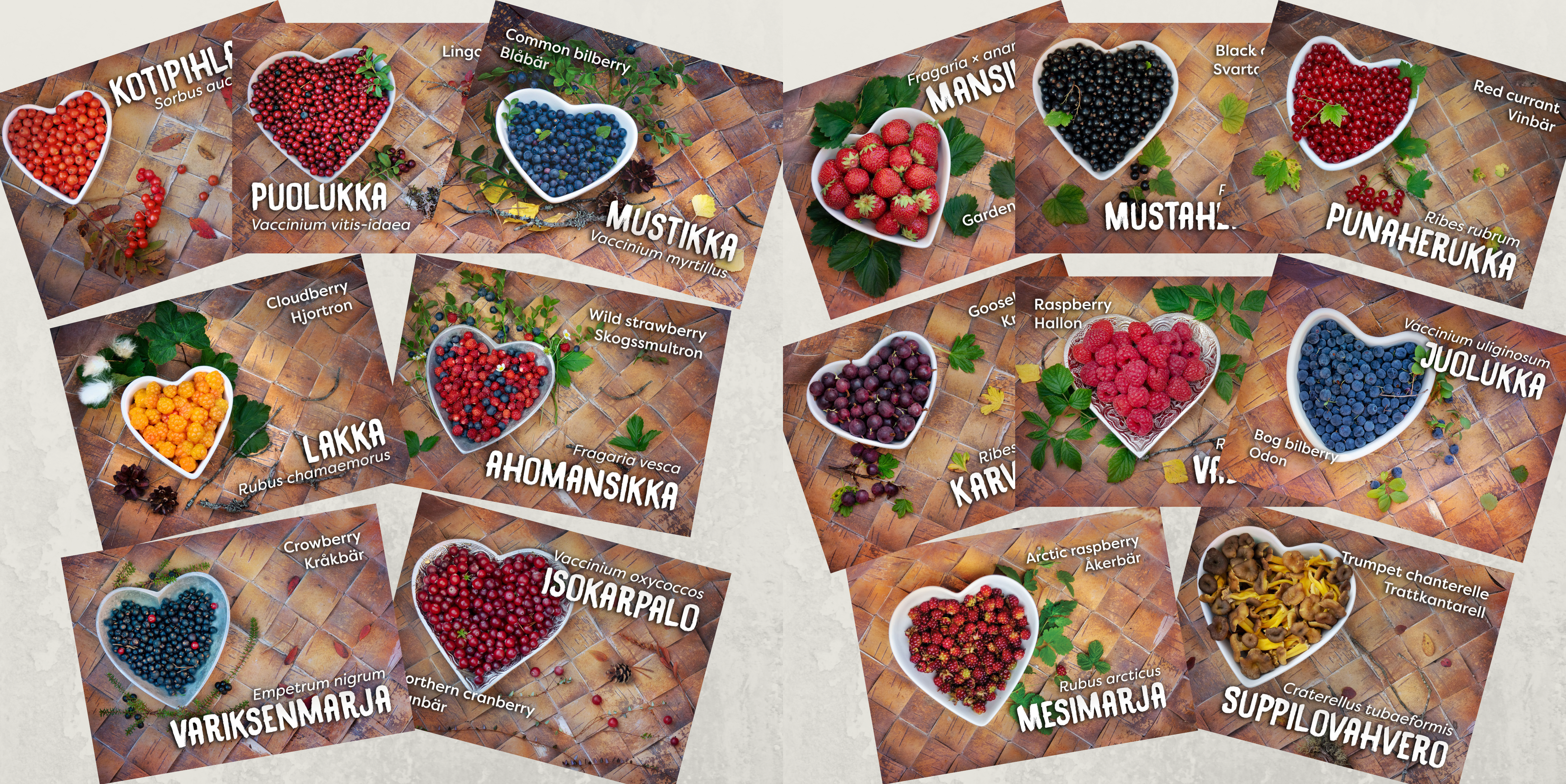
These berry cards have hearts full of Finnish nature’s gifts. Some are cultivated species, but the majority are wild berries that anyone can pick with the traditional right of every man (everyone`s rights). The package is completed by the catch of the autumn forest trip, Trumpet chanterelle. Save your favorite berries for your own collection and send berry greetings to a friend – the perfect way to share a piece of Finnish nature with the world.
Set 1 includes these postcards :
Rowan pomes – Rowan pomes are known for sour taste and are therefore often used among other berries or fruits. Those have a lot of vitamin C and the “berries” are easy to collect in a good harvest year. Rowan is a sacred tree in folklore.
Lingonberry – The traditional berry of Finnish forests, the lingonberry, offers a sour taste experience. Lingonberry is versatile, it is used in sweet porridges, jams and pastries or as an addition to savory dishes, such as a cabbage casserole or sautéed reindeer. Lingonberry grows all over the country and it is the most picked natural berry in Finland.
Bilberry – Bilberries have a mild taste, they contain e.g. a lot of vitamins and fiber and they have been studied to have a good effect on health. Blueberry pie is the best summer pastry!
Cloudberry – The cloudberry grows in swampy areas and it is sensitive to the effects of the weather and the yield varies from year to year. When picking berries is slow and heavy, their price is high and they are the most valuable natural berries in Finland. Cloudberries contain vitamin C and those are used as a treat, e.g. as jam with ice cream or bread cheese (Finnish squeaky cheese).
Wild strawberry – The small and sweet wild strawberry represents Finnish summer nature at its best. As natural pastures decrease, it is dificult to find those, but when you do find them, they are a very special treat. The berries should be eaten as they are, because their taste becomes bitter when heated.
Crowberry – The mild-tasting crowberry has a lot of vitamins and it grows all over the country up to the fells of Lapland. It is used together with other berries, e.g. as material for juices. The crowberry is an important source of food for animals and birds in the north, and traditionally the berry was an important source of vitamin C for the inhabitants of the north in winter.
Northern cranberry – Known as a health berry, the cranberry grows in marshy areas almost throughout Finland. The plant grows creeping along the ground and its berries ripen late, only at the time of the first frosts. The sweetened berries under the winter snow are edible even in spring if you happen to find them!
Set 2 includes these postcards :
Garden strawberry – Garden strawberries are grown throughout Finland, including Lapland, and are the most commercially significant of the cultivated berries. The perennial strawberry spreads from seeds in addition to runners. The taste of strawberries varies from quite sweet to tart, depending on the variety and intended use. Strawberries are traditionally bought at markets or picked from berry farms as a summer delicacy or to preserve for the winter. Strawberries are healthy and light to eat, containing a lot of vitamin C and fiber but little energy.
Blackcurrant – Blackcurrant is the most common cultivated currant, which also grows wild in almost all of Finland. The black berries contain a lot of vitamins C, E and K and fiber. The berries are used to make jelly and jam, which are especially suitable as a side dish for meat dishes, as well as liqueur and juice. The berries and leaves have been traditionally used as a medicine for various ailments and are believed to contain many substances that have a positive effect on health – who wouldn’t have drunk hot blackcurrant juice to relieve the symptoms of a cold!
Redcurrant – Redcurrants are more resistant to cold than blackcurrants and are therefore grown further north, including in Lapland. Redcurrant berries and leaves have also been used as a traditional medicine for various ailments. The tart redcurrant is a popular juice berry and contains more vitamin C than blackcurrants.
Gooseberry – Gooseberries are a member of the currant family and their berries can be yellow, green, or red. They are eaten fresh, used in desserts or juices, and preserved as jams, marmalades, and jellies.
Raspberry – Wild raspberries, common almost throughout the country, are more aromatic than the cultivated garden raspberries shown on the card. Raspberries are a pioneer species and can be found, for example, in logging areas. Raspberry berries appear in the second year of growth. Raspberries are used to make jams, juices and drinks. Dried raspberry leaves are suitable for tea and have been used as a folk remedy for women’s ailments.
Bog bilberry – Bog bilberry is a common shrub plant in marshy areas throughout the country, larger than blueberries. Its blue berries resemble bilberries but have a milder taste, which is why they are not widely used. It is worth collecting them, even if they are used for juice or jam in addition to bilberries, because it is easier than collecting bilberries, there are usually many berries and they contain a lot of vitamin C.
Arctic raspberry– The arctic raspberry is a particularly delicious, aromatic berry. The berries in the picture have been borrowed for the purpose of photographing, as the berry is rare in nature. The berries are used, for example, to flavour liqueurs or teas and their taste becomes bitter when heated.
Trumpet chanterelle – Small and horn-shaped, the trumpet chanterelle is an excellent late-growing edible mushroom. Its pileus, the cap is brownish-yellow, up to five centimeters wide, and in the middle there is a funnel that continues into a hollow yellow stipe. The underside of the pileus has folds, false gills, that resemble gills. The mushrooms are small, but they grow in groups – when you find one, after a while you will notice many more mushrooms near the first one! Trumpet chanterelle is abundant in southern and central Finland and even in the Arctic Circle, but not in the very north. The mushrooms are most often found in September and October, and usable mushrooms can still be collected after frost and snow have set in. The mushroom is a delicious edible mushroom that can be used in cooking or preserved by freezing or drying without pre-treatment. The use of Cantharellus lutescens, which resembles the trumpet chanterelle, is similar to the trumpet chanterelle.
Sets are sold separately also, but this is a bargain set. In this set the price of one card is only 0,74 euros!


